
2025 · Hardware / Robotics
ROS2 Quadruped — Stepper Drive + 8-Servo Legs, Tunable From a Tkinter GUI
A four-legged walker built on ROS2 Humble with stepper-motor drive, eight servos, and a joint-visualization GUI that records and plays back gaits.
Robotics Control · ROS2 + Forward Kinematics
The problem
The ground half of the litter-recovery system needed legs: a robot small enough to be lowered near a target object, with independent motorized motion per leg and enough precision to be tuned by hand. The default approach — writing gaits as hard-coded angle arrays in firmware — makes every mechanical adjustment a code rebuild, and a cart built that way can never be tuned on the bench.
The constraint
Two motors do the heavy lifting: steppers drive the coarse locomotion and eight servos articulate the four legs. Everything had to run from a single Raspberry Pi while staying controllable in real time — and it had to be tunable without recompiling, since a walking gait is more about feel than about any closed-form formula.
What I built
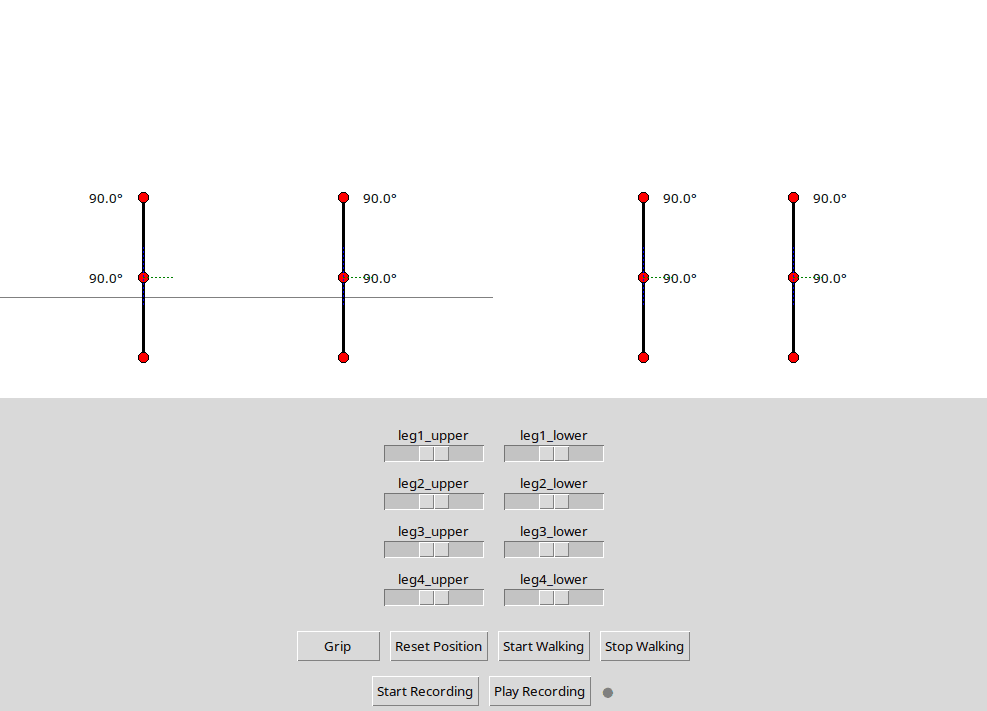
Two ROS2 Humble packages split the problem down the middle. robot_controller owns the hardware: a topic with a tiny text protocol ('L'/'R' rotate a stepper 512 steps, 'S1:90' moves one servo, "A 90;B 45;…" moves several at once) mapped onto RPi.GPIO driving the 4-wire stepper sequence and eight 50 Hz servo channels — with an explicit simulation fallback when RPi.GPIO is missing, so the logic is developed before any wiring. The other half, robot_interface, is the GUI: a Tkinter app that renders the robot live by solving forward kinematics in screen space (leg angle → knee → foot, a debug overlay showing perpendicular references), lets you drag joints or fine-tune sliders, and records a stream of joint frames for playback as a repeated gait. Because the two packages talk only through the topic, the GUI can sit on a laptop while the controller runs on the Pi.
The outcome
A walkable quadruped whose gate is data, not code: record a pose slowly, play it back smoothly, then drag joints to fix just one leg. The same hardware + topic split became the recovery path of the autonomous-litter research platform the paper describes.