
2024 · Hardware / Robotics
GreenGuardian — Autonomous Weed-Spotting Rover
A Raspberry Pi 4 + TensorFlow Lite rover that drives a field, finds weeds by vision, and spot-sprays only them. Bronze medal, Canada-Wide Science Fair 2024.
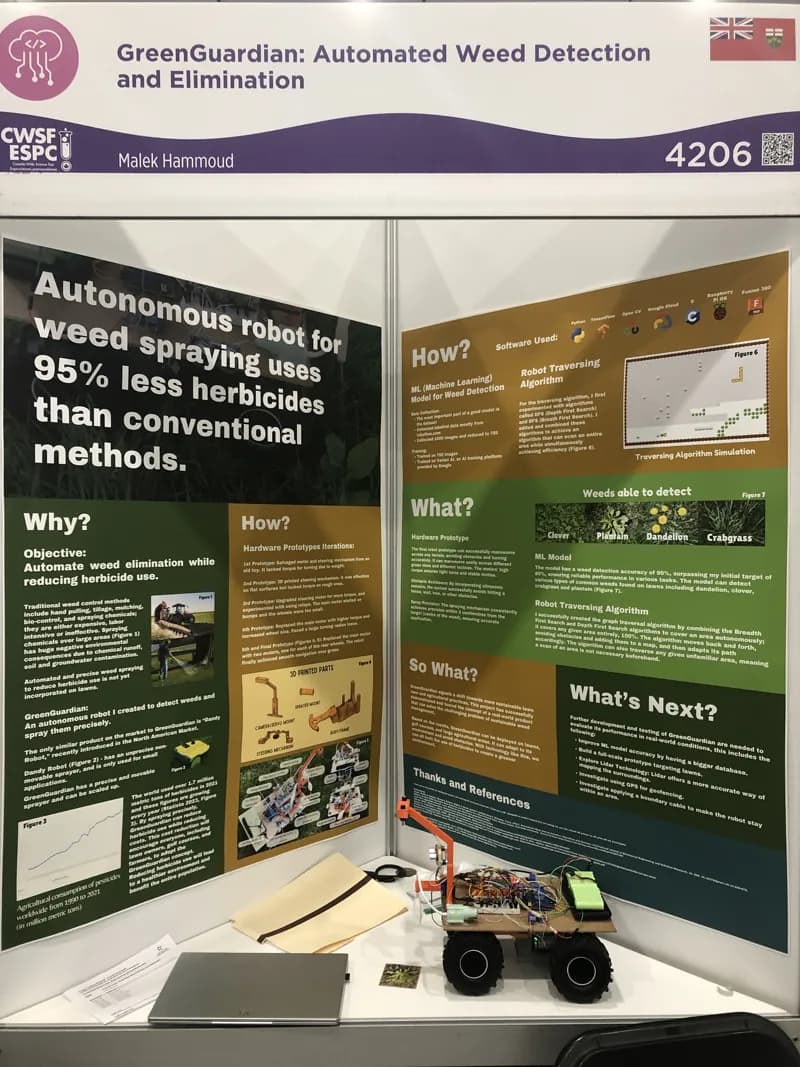
Canada-Wide Science Fair Bronze Medal · 2024
The problem
Broadcast herbicide is cheap to deploy and ecologically brutal: over 90% of what a boom sprays lands on soil and healthy crop instead of on the weed, poisoning groundwater and accelerating herbicide resistance. The affordable anti-answer — mechanical weeding rigs — runs into the hundreds of thousands of dollars.
The constraint
Everything had to fit on a hobby budget and survive a real field: outdoor light that swings between harsh sun and shadow, rough uneven soil, and a compute budget of one Raspberry Pi 4 (running an int8 TensorFlow Lite model) plus a Raspberry Pi Pico for the real-time actuator loop. Precise spray *position* had to come from cheap hardware, not a RTK receiver.
What I built
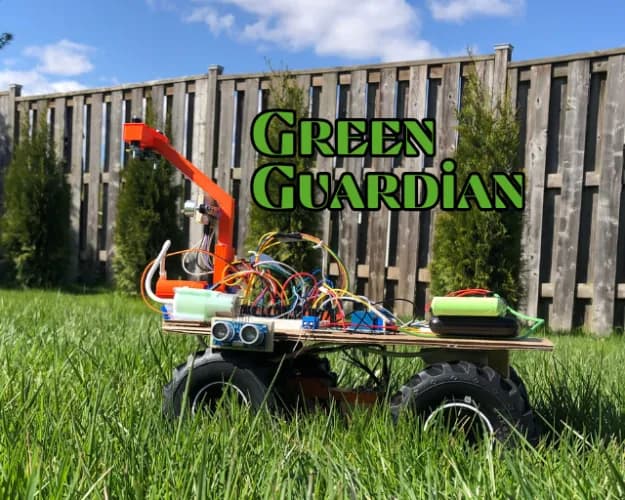
Three drive iterations ended on two independent high-torque rear motors with skid steering (zero-radius turns) driven by a Pico over 2 Mb/s serial. The sensing stack is deliberately two-stage. Stage one: a custom TFLite classifier trained on weed classes (dandelion, crabgrass, blowballs, clover, plantain) runs at 0.25 confidence on a wide 2304×700 strip. Stage two — the part that makes spray land on the weed — an HSV threshold finds the yellow flower's bounding box and normalizes it to image coordinates, so the actuator knows (x,y) precisely, not just "a weed". A magnetometer (HMC5883L) keeps heading so the rover turns 180° at row ends and drives the next row. The Pico firmware pulses the 12 V solenoid for ~0.15 s only when the spray point is centered under the weed.
The outcome
94% weed classification precision, ~90% reduction in sprayed herbicide volume versus broadcast, and a Bronze Medal at the 2024 Canada-Wide Science Fair (CWSF) in Ottawa.