
Basil Home AI — Building an Embedded Smart Fridge Engine on QNX RTOS
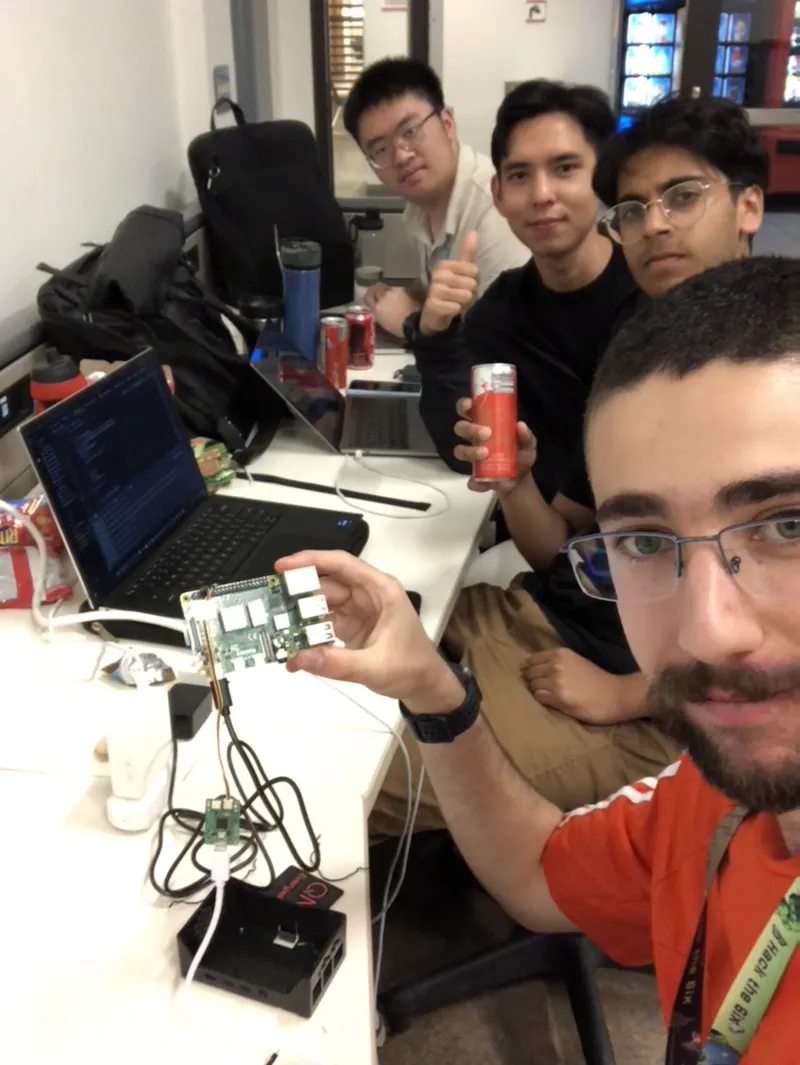
How our four-person team turned QNX RTOS, a Raspberry Pi camera, a custom YOLOv5 model, a FastAPI inventory backend, and Gemini into a working smart fridge at Hack the 6ix — and won Deloitte's Best Use of AI for Green.
The problem: waste is a visibility problem
In Canada, over half of all food produced is wasted, and the average household throws away more than $1,300 a year. Most of it comes from two blind spots: buying what you already own (buried at the back of the fridge), and letting what you own expire before you think to cook it.
The "smart fridge" answer usually means a $2,500+ appliance. FridgeMind set out to make a retrofit: add vision + AI to the fridge you already have. Our four-person team had 36 hours.
The architecture: four stacks, one thread
We split the build like a real product, one familiar piece per person:
- QNX RTOS + Raspberry Pi — the "brain" and camera-in-the-fridge node.
- Custom YOLOv5 — grocery detection from the live stream.
- FastAPI backend — inventory state, expiry logic, recipe routing.
- Expo app — the interface, with AssemblyAI voice for hands-free use.
What made it hard isn't any single piece — it's that all four had to agree on the same data flow by morning: camera frames → detection counts → backend inventory with expiry → a recipe prompt, then a mobile app rendering the result.
Why QNX RTOS on the hardware side
The hardware job is sneaky-hard. The moment the door closes you want an image captured and served immediately, and that's a hard-real-time promise desktop Linux doesn't make well — it boots slowly and schedules inconsistently. BlackBerry QNX RTOS is built for exactly this: microkernel isolation, deterministic scheduling, and a small footprint.
For me the personal milestone was shipping a working QNX system at all: standing up the network, getting dependencies onto it, and getting the camera stream out within a hackathon — an OS many engineers only touch in safety-critical contexts.
The computer vision pipeline
import torch
model = torch.hub.load('ultralytics/yolov5', 'custom', path='weights/exp14-last.pt')
model.conf = 0.8  # only confident detections touch inventory

detections = results.pred[0]
object_count = {}
for x1, y1, x2, y2, conf, cls in detections:
    label = model.names[int(cls)]
    ...
# POST per-class counts to the backend
requests.post('http://localhost:5000/food-detect', json=object_count)
The model was trained on 300+ hand-curated food images, and the loop deliberately keeps a high confidence floor so a blurry frame can't invent groceries. Per-frame class counts — not a raw box stream — are what a hackathon-length backend can actually store and reason over.
The clever bit: expiry before recipes
Most "food waste" demos just list what's there. The difference that won the green-AI track is that our backend ranked the inventory by urgency before the LLM ever saw it, splitting the fridge into:
🚨 USE TODAY/TOMORROW   (≤ 2 days)
⚠️  USE WITHIN THE WEEK  (3–7 days)
✅  GOOD FOR LATER       (8+ days)
Then Gemini was prompted to turn the soonest-expiring bucket into recipes — not "what's in the fridge" but "use this before it goes bad." That's the mechanism that converts recognition into actual waste reduction, and it's why the demo read as a product and not a gimmick.
What actually won
The Deloitte judges judged a live flow: camera in a real fridge → inventory updating on screen → recipes generated on the spot, in seconds, with the live camera feed visible. The lesson that generalizes to any hardware hackathon: make the data path observable. If the judges can watch a detection appear in your app within a second of the door closing, the pitch is made.
From FridgeMind to Basil
The inventory+recipe hearts survived the weekend: FridgeMind, rinsed and repackaged, became Basil — a kitchen assistant with a production FastAPI backend and an Android app, carrying the same camera-to-expiry-to-recipe core into a startup-shaped product. The Rabbit-Hole hackathon project turned out to be the smallest thing it would ever be.
Related Project Case Study
Basil Home AI — Smart Refrigerator Inventory Engine
Co-created FridgeMind at Hack the 6ix 2025: a QNX-RTOS Raspberry Pi fridge node, a custom YOLOv5 grocery detector, a FastAPI inventory backend that ranks food by expiry, and Gemini-generated zero-waste recipes. Won Deloitte's Best Use of AI for Green. Later grew into the Basil kitchen assistant.